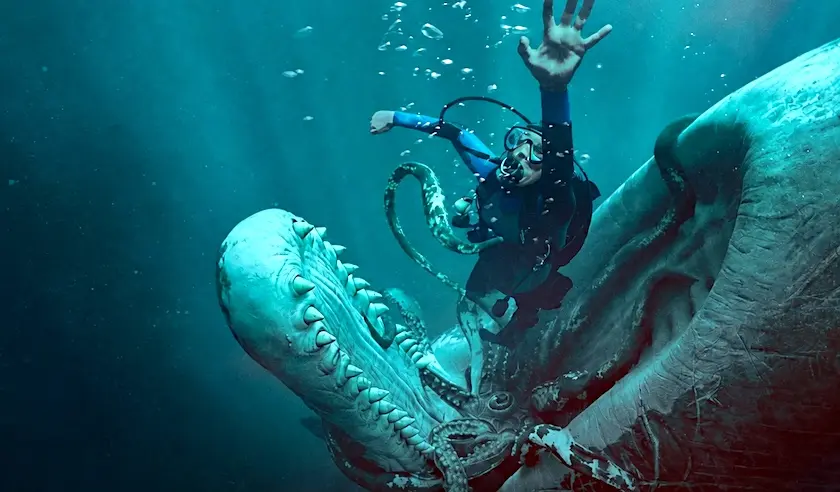
AI can conjure up characters and entire worlds. Filling cinema seats is proving a much tougher trick. Sanxingdui: Future Past, billed as China’s first fully AI-generated theatrical feature, has landed with a thud at the box office.
The sci-fi film was intended to showcase what artificial intelligence could bring to filmmaking. Instead, its disappointing debut has raised questions about whether audiences are ready to pay for movies built around AI-generated imagery.
The Box-Office Numbers Aren’t Pretty
Released in Chinese cinemas on October 23, Sanxingdui: Future Past had earned just 1.495 million yuan (approximately US$210,000) as of October 30, according to figures from box-office tracking platform Lighthouse Professional Edition, reported by Blue Whale News.
More on Screen Realm:


That’s a fraction of its reported production budget of more than 10 million yuan (US$1.5 million). The tracking platform was also projecting a final theatrical gross of just over 3 million yuan, although that forecast could change as the release continues.
And it wasn’t exactly a small release. More than 10,000 screenings were scheduled across China on opening day. Yet just over a week later, the film’s share of nationwide cinema screenings had fallen to just 1%, accounting for only 0.6% of admissions, according to Jiemian News. At one Beijing screening attended by AFP, just four people were in the audience.
Ironically, It’s a Movie About the Dangers of AI

The film’s premise makes the situation even more amusing. The roughly 100-minute sci-fi thriller follows an archaeologist attempting to save a future world enslaved by artificial intelligence. Yes, the movie warning us about AI was made using AI.
Every character and backdrop was generated using AI, along with some of the film’s audio, according to a disclaimer in its opening credits, as reported by The Beijing News. That doesn’t mean humans weren’t involved, however. Production company Bona Film Group says nearly 100 people spent more than two years working on the film.
Bona Film Group executive Jiang Defu acknowledged the lukewarm reception but defended the achievement, telling Chinese film industry outlet Yuli: “We are the first to try it, the first to get a theatrical release permit and the first to be tested by the audience.”
Not everyone was convinced. One woman who attended a free preview told AFP she wouldn’t have paid for a ticket, although she suggested that could change if AI filmmaking eventually delivered a theatrical experience comparable to James Cameron’s Avatar films.
The criticism hasn’t been limited to the technology itself. Chinese filmmaker Guan Yadi told Blue Whale News that the film suffers from disconnected scenes and underwhelming sound design, arguing that AI productions should still be held to the same storytelling standards as any other theatrical release.
Can Fully AI-Generated Movies Actually Make Money?
It’s not as though AI-generated entertainment is struggling everywhere in China. According to Fortune, citing Chinese publication Caixin, more than 95% of the country’s 120,000-plus microdramas released in the first quarter of 2026 were AI-generated.
Clearly, there’s an audience for short-form AI content. Convincing people to pay for a feature-length cinema experience is another matter.
For an interesting comparison, consider Niu Lai, a crudely animated Chinese feature made by a mother-and-son team over five years. The film initially struggled before going viral for its bizarre visuals, eventually earning around 64.3 million yuan (approximately US$9.6 million), as reported by Cartoon Brew.
Reported estimates of Niu Lai‘s production budget vary considerably, although Reuters puts the cost in the thousands of dollars. Either way, not bad for a shoestring production whose rough animation became part of its unlikely appeal.
Meanwhile, Hollywood continues experimenting with generative AI, even as the technology raises concerns about jobs, performers’ likenesses and the future of human creativity. Another AI-assisted sci-fi feature, Gods Don’t Give Gifts, is scheduled for a limited US theatrical release on December 4.
Of course, one theatrical flop doesn’t mean AI-generated movies are doomed. The technology is developing rapidly, and future productions could offer better visuals, stronger storytelling and significantly lower costs.
Whether those improvements will eventually translate into profitable theatrical releases remains to be seen. For now, Sanxingdui: Future Past offers a costly reminder that a technological breakthrough and a box-office attraction aren’t necessarily the same thing.
More Movie News:
‘Smile 3’ Moving Ahead With New Director as Parker Finn Steps Away
Joey King Falls for LaKeith Stanfield’s Alien in Provocative Sci-Fi Rom-Com ‘Safe Space’