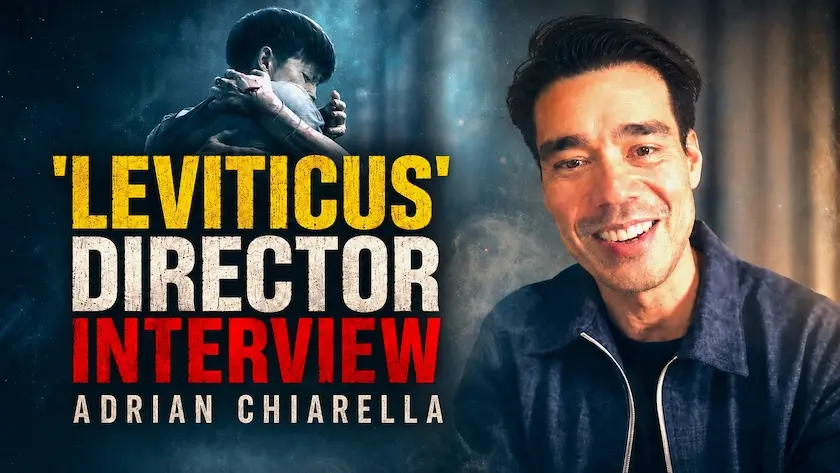
A decade in the making, a surprise audition that helped rewrite its ending, and the challenges of working with a limited budget. Horror film Godmother marks John Veron’s feature directorial debut, and with the film receiving special Australian screenings at this year’s Monster Fest, the director and co-writer joined Screen Realm to reveal how it all came together. Watch our complete interview above and get the details below.
The film follows Theo (Paige Evans), who heads to the New Mexico desert for a romantic getaway with her boyfriend Colby (Cameron Cuffe), only for her newly single sister Katie (Riley Dandy) to unexpectedly tag along. Their secluded rental seems ideal, until a group of suspiciously friendly retirees, including characters played by horror legend Dee Wallace and Oscar nominee Bruce Davison, take a sinister interest in Theo.
More on Screen Realm:


From a Nine-Day Writing Challenge to a Horror Feature
Believe it or not, Godmother began as something of a personal experiment. Back in 2016, Veron took two weeks off work and challenged himself to write a feature screenplay in nine days, setting a target of ten pages per day. With his producing background in mind, he also wanted something that could realistically be made on an independent budget.
“I’m a producer for my day job and I know how to produce,” Veron explained. “So I came up with it as a very producer-friendly, indie-friendly script, which is like: limit your locations, limit your cast, limit the number of big effects set pieces so that when you have big effects set pieces, they’re memorable.”
There was just one problem: his outline ran out after six and a half days, leaving him with around 65 pages and a story that needed considerably more work. Multiple drafts followed, gradually bringing themes of bodily autonomy, generational expectations and control into sharper focus.
The screenplay eventually became one of the top three horror finalists at the Austin Film Festival, helping Veron secure a manager and gain access to meetings within the studio system. But after years developing other projects without getting one into production, he decided to take matters into his own hands.
In 2024, he approached producer Craig Sherwood, initially offering him $750 to break down the screenplay and prepare a budget. Sherwood had another idea: forget the money and let him produce the film. Casting and fundraising followed, finally putting the long-gestating project on the path to production.
As for stretching the film’s resources, particularly when it came to its more ambitious horror elements, Veron had a straightforward philosophy.
“I promise I gave you guys as many monsters as I could afford,” he laughed. “I’d rather give you fewer better monsters than more crappier monsters.”
The Biggest Surprise of Directing His First Feature
Although Veron had experience directing short films, moving to a feature proved a considerably bigger adjustment than simply extending the shooting schedule.
“Nothing can possibly prepare you for going from making short films to features,” he told Screen Realm. “The thing that surprised me most was the amount of control you have to give up because the scale of the endeavour has gone up.”
His previous shoots had never lasted more than two days, allowing him to meticulously plan and block virtually everything. That approach became unsustainable almost immediately on Godmother, forcing him to put greater trust in his cinematographer and fellow creatives.
“Your job is not to have every idea. Your job is to filter all the ideas, including yours. Like, don’t have no ideas. Have thoughts, please. But filter the ideas that you’re having and that other people are having, and have the discernment necessary to know what’s a good idea. Not just a good idea, but a good idea for this movie specifically.”
As it turned out, one of the film’s most significant creative contributions came from someone who originally auditioned to be in front of the camera.
Alanah Pearce Auditioned for the Lead Before Changing the Film’s Ending

Australian gaming journalist and personality Alanah Pearce ultimately became a producer and co-writer on Godmother, but that’s not why she initially met Veron and his team.
Pearce actually auditioned for the lead role of Theo. During her Zoom callback, however, most of the allotted half-hour was spent discussing the project rather than performing. Although the filmmakers decided she wasn’t quite right for the part, Veron was impressed by how well she understood what they were aiming for.
“What I remember is thinking, this person really, really gets what we’re trying to achieve,” he recalled. “One of the things you’re always looking for when you’re bringing people on, because honestly that’s most of what directing is, is hiring and casting, are you bringing people on that understand the vision of what you’re trying to accomplish?”
Veron and Sherwood subsequently offered Pearce a producing role, which she accepted. She began assisting with financing and screenplay development, but it wasn’t long before she challenged one of the story’s biggest creative decisions.
“The original ending was quite a bit darker than what you saw,” Veron revealed.
Pearce had discussed the material with other women and believed the conclusion needed changing. Given the film’s exploration of pregnancy and bodily autonomy, Veron felt it was important to consider perspectives beyond his own.
“There’s a moral case for it, which is people should be involved in telling their own kinds of stories. I don’t think it’s appropriate for me to tell a story about this without involving any women,” he explained. “And there’s also a mercenary case for it, which is you’re just going to get a better, more authentic product if you involve people.”
After taking a day to consider Pearce’s suggestions, he agreed that her proposed ending was stronger. Her contributions subsequently extended into writing additional screenplay material, including helping refine a particularly challenging poolside conversation between Theo and Wallace’s character.
Veron recalled sending Pearce dialogue he thought he’d finally cracked, only for her to respond: “Hey, John, these are really good pages for, like, a different movie.”
She felt the scene wasn’t sufficiently connected to the film’s larger ideas. Veron agreed and rewrote it, while Pearce’s growing contributions eventually earned her a full co-writing credit. He couldn’t have been more appreciative, telling us that Godmother wouldn’t have happened without Pearce and that, even if it had, “it wouldn’t be as good.”
Paige Evans Went Above and Beyond for ‘Godmother’

At the centre of the escalating nightmare is Paige Evans, delivering a committed performance as Theo, a character who finds herself under increasing emotional and physical pressure.
Evans came to the production through casting director Cameron Burns, who knew her work from previous genre projects, including Sorry About the Demon. Veron joked that she had the sort of face that makes audiences immediately want good things to happen to her. Naturally, he decided to make the opposite happen.
The actress spent considerable time building her character’s relationships with Riley Dandy and Cameron Cuffe before filming. Interestingly, Dandy and Cuffe deliberately avoided getting to know each other beforehand, preserving the unfamiliarity between their characters.
But perhaps the most telling example of Evans’ dedication came after she’d finished shooting. Veron recalled arriving on set for the final day of principal photography and finding her helping the art department unload equipment, despite having already wrapped her scenes.
“She just loves film and loves the process,” he said. “So on the weekends, we went out and shot some B-roll, just me and my DP, and she was like, ‘I want to come. I want to learn how cameras work.’ She is so down to learn every aspect.”
That enthusiasm extended to developing Theo, with Evans encouraged to challenge any choices that didn’t feel authentic to her character. Veron has high hopes for her career, joking that he’s lucky to have worked with her now because, in a few years, she might be too busy to return his calls.
Working With Horror Royalty Dee Wallace and Bruce Davison

For a first-time feature director, assembling a cast featuring The Howling and Cujo star Dee Wallace and Oscar nominee Bruce Davison (Longtime Companion, X-Men) was quite the achievement. Both were near the top of the filmmakers’ wish list for the sinister Martinsons, and Wallace came aboard after an initial meeting with Veron.
What he discovered was that the two veterans, along with the film’s younger performers, had distinctly different approaches to acting.
“Every one of your actors speaks a different language, and it’s not reasonable to expect them to all speak your language,” Veron said. “Part of your job is to figure out their language and how to coach them to the performance you’re looking for.”
Wallace, he explained, works from an intuitive, character-driven perspective. Even something as simple as moving across a room requires an understanding of why her character would make that decision. Cuffe, meanwhile, was considerably more flexible about physical direction, telling Veron at one point: “I’m an action figure. Just put me wherever.”
Davison brought another perspective entirely, along with a surprising connection to his co-star. Veron revealed that he only discovered after casting Davison that the actor and Wallace had previously played husband and wife several times. Their existing friendship helped establish the Martinsons’ chemistry.
Drawing on his familiarity with classic Westerns, Davison explained their dynamic with a memorable comparison: “I’m Gabby Hayes and she’s John Wayne.”
“He’s there and he’s a pop of colour, but he’s not supposed to take the spotlight from Mrs. Martinson,” Veron explained. “Bruce understands how to contribute to an ensemble overall and he has a really holistic idea of what to bring as a performer, which I think comes from his theatre background.”
What’s Next for John Veron?
Veron is already writing his next project, titled A Machine in the Dark. And his wonderfully strange elevator pitch? A story about “the perils of maintaining male friendships in your 30s and 40s… and also a Goatman.” Consider us intrigued.
Meanwhile, Godmother has also been featured at Australia’s Monster Fest 2026, with special screenings across Perth, Brisbane, Sydney and Adelaide. More details can be found on the festival’s official website.