
Written by Zac Platt.

There’s nothing else that feels the way Gravity does. Its weightlessness and terrifying freedom aren’t just the film’s conceit, they’re its thesis. Every part of this gorgeous film work in unison; the cast, soundscape, camera, even the props. All of it in perfect harmony both stylistically and thematically. If Gravity ever flies too close to the sun it’s in the expositive backstory that at first seems a little thin, but on reflection is integral in communicating the philosophical backbone. If these moments are lacking it’s only in contrast to the breathlessness and wonder that occupy every other second of this movie. An incredible story of survival in a unique setting, Gravity is a triumph of exospheric heights.
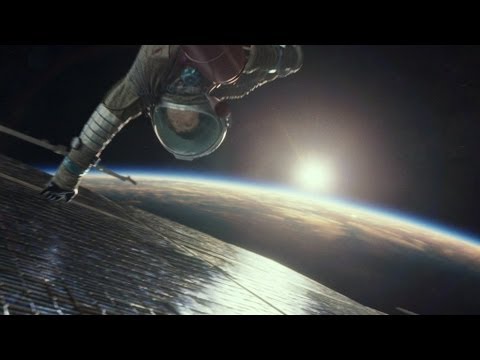
Gravity is the story of Ryan Stone (Sandra Bullock) and Matt Kowalski (George Clooney), two astronauts marooned by a debris storm wreaking havoc on Earth’s scattered satellites. Director / co-writer Alfonso Cuarón again employs the long mobile takes that made Children of Men so compelling. It’s a wonderful technique for establishing spacial awareness, and it feels even more at home in Gravity. The opening sequence swoops in and out from the astronauts as they go about their business, follows them through the chaos of the storm, and even enters Ryan’s helmet before we see a cut. It makes the camera, and by extension the viewer, feel just as weightless as the cast.
Each set-piece is astoundingly complex but still feels organic and real, like an intricate painting with invisible brushstrokes. Gravity’s compositions are heart-stopping; the applications of depth, color and negative space make every shot a work of art in its own right. As cynical as some are about 3D (myself included), it’s impossible to argue this film’s atmosphere isn’t improved by the added depth.

The sound design also deserves special mention. Steven Price’s ever-present score swells and simplifies as tension rises and falls. It keeps the cast and audience temporally parallel, solidifying the already overwhelming suspense. The silence of space is in beautiful contrast to the destruction happening all around, making it seem even more unmanageable and frightening. The sound is essential in foreshadowing and building tension so that you’re already on the edge of your seat when the film so unceremoniously transitions from calm to calamity.
Ryan is an easy character to root for. From the moment we first meet the medical engineer, Bullock ensures she is human and vulnerable. The fear and defeat in her eyes when she is spinning out of control away from Earth is heartbreaking. Admittedly, some of her monologues are a little heavy-handed, especially when she delves into her past. This is the easiest thing to nitpick about the film, but it does make sense for the character and is necessary in selling the themes of hope and determination that drive Gravity home.
Kowalski is an important reprieve from Gravity’s unrelenting suspense. Playing his regular charming self, Clooney adds some levity and humor at first, but even this is eventually used to build a sense of uncertainty as it becomes obvious he’s just trying to keep Ryan calm. More than anything Kowalski is a framing device to give context to Ryan’s arc, but Clooney brings a dynamic to the character that’s key to the film’s personality.
More than a film, it’s an experience. The sound and visual composition is ingeniously designed in minute detail to keep the audience lost in space right alongside Bullock and Clooney. This is Buried meets 127 Hours – in space. It’s a meditation on the indomitable human spirit and taking charge in the face of futility. It teaches us that no matter how powerless you feel, no matter what the outcome, you only fail if you don’t give it your all; Cuarón does exactly that. Original, thrilling and ultimately inspiring, Gravity is a masterpiece on every front.
 THE REEL SCORE: 10/10
 – Z.P.


